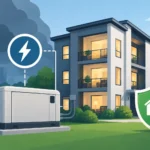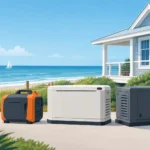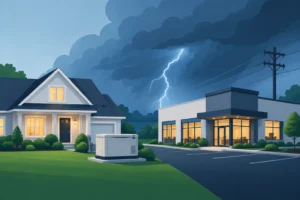

A standby generator can be fueled, properly sized, and ready for a storm, but it still needs a healthy battery to start. Generator battery lifespan is easy to overlook because the system usually sits quietly outside for months at a time. Along Alabama’s Gulf Coast, however, summer heat, humidity, salt air, and long periods between outages can shorten battery life faster than many homeowners expect.
For a home or business that depends on automatic backup power, the battery is not a small detail. It is the component that helps the generator start when utility power drops. A weak battery can turn a well-planned protection system into a manual problem at exactly the wrong moment.
How Long Does a Generator Battery Last?
Most automatic standby generators use a 12-volt starting battery, often a sealed lead-acid battery. In favorable conditions, many last around three to five years. On the Gulf Coast, planning for the lower end of that range is usually the practical choice, especially when a generator is installed in a hot, exposed location.
There is no single replacement date that fits every system. Battery quality, installation conditions, generator use, maintenance history, and the condition of the charging system all matter. A battery may test strong after three years, while another can lose capacity much sooner after repeated heat exposure or corrosion at the terminals.
The battery does not run your air conditioning, refrigerator, lights, or business equipment during an outage. The generator engine and fuel supply handle that work. Its job is still essential: it provides the power needed to crank the engine and support the controls that allow the system to start automatically.
Why Gulf Coast Conditions Affect Generator Battery Lifespan
Heat is one of the biggest enemies of a starting battery. High temperatures speed up the chemical reactions inside the battery, which can shorten its service life even when it appears to be functioning normally. A battery that performs adequately on a mild spring day may struggle after a long stretch of summer heat in Daphne, Fairhope, Gulf Shores, or Orange Beach.
Humidity and salt-laden coastal air can add another concern. Corrosion on battery terminals and cable connections can interfere with the flow of power. Even a relatively new battery may have trouble starting the generator if its connections are loose, dirty, or corroded.
Long idle periods also matter. Standby generators exercise regularly, but they may not operate under a true outage load for months or years. That means a battery can gradually weaken without giving an obvious warning. When severe weather arrives, the first real demand placed on the battery may be the moment it is least able to perform.
Signs Your Generator Battery May Be Failing
A professional service visit is the best way to evaluate battery condition, but property owners can watch for a few practical warning signs. The generator may crank slowly during an exercise cycle, fail to start on schedule, or display a battery-related alert on its controller. Some systems may show a warning light or send an app notification, depending on the equipment and monitoring setup.
Visible corrosion around the terminals deserves attention, as do swollen battery cases, loose cables, leaking fluid, or an unusually old battery with no record of replacement. Do not assume that a generator which started last month will start during the next hurricane. Batteries often decline quickly near the end of their useful life.
If your generator has failed an exercise cycle or issued an alert, schedule service promptly. Resetting an alert without identifying the cause can leave a hidden problem in place. A trained technician can test the battery, inspect the charger and connections, and determine whether replacement is the right solution.
What Helps a Standby Generator Battery Last Longer?
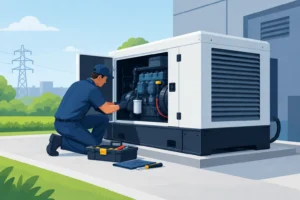
The most reliable approach is regular professional maintenance. During a service visit, a technician can load-test the battery, check voltage, inspect cables and terminals, verify the charging system, and look for corrosion or enclosure issues. This is more useful than relying on appearance alone.
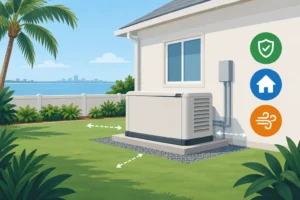
Keeping the generator area clear also helps. The unit needs proper airflow, and the enclosure should remain free of leaves, mulch buildup, standing water, and overgrown landscaping. A clean, accessible installation makes inspections easier and reduces the chance that moisture or debris creates problems around the generator.
It is also wise to keep a record of the battery installation date. If you purchased a home with an existing standby generator, ask when the battery was last replaced and whether maintenance records are available. A battery of unknown age should be treated cautiously, particularly before hurricane season.
Avoid trying to substitute a car battery simply because it fits the compartment or has similar voltage. Generator batteries must meet the manufacturer’s specifications for size, terminal configuration, cold-cranking capability, and compatibility with the charging system. The wrong battery can create starting issues, controller warnings, or premature failure.
When Should You Replace the Battery?
Replacement should be based on testing and age, not guesswork. If a battery tests weak, shows physical damage, has excessive corrosion, or is approaching the expected end of its life, replacing it before storm season is usually the safer decision. The cost and inconvenience of proactive replacement are small compared with discovering a no-start condition during an extended utility outage.
For many Gulf Coast standby generator owners, an annual maintenance visit is the ideal time to review battery health. This gives you a clear picture before the most active severe-weather months and helps prevent last-minute service calls when demand is high.
Businesses should be especially deliberate. A battery problem can interrupt refrigeration, security systems, point-of-sale equipment, communications, internet service, and other critical operations. Property managers also need to consider the impact on tenants, common areas, gates, pumps, and safety systems. In these settings, documented maintenance and timely replacement are part of protecting continuity, not simply caring for equipment.
Battery Problems Can Point to Larger Issues
A dead or weak battery is not always just a battery problem. Repeated battery failures can indicate an issue with the generator’s charger, wiring, controller settings, engine starting system, or environmental conditions around the unit. Replacing the battery alone may temporarily restore operation without resolving the underlying cause.
That is why experienced standby generator service matters. A complete inspection looks beyond whether the engine starts today. It checks whether the automatic transfer process works as intended, whether the generator is charging correctly between exercise cycles, and whether the system is prepared to carry the loads it was designed to support.
For homeowners, this means confidence that the essentials can remain available during an outage: climate control where capacity allows, refrigeration, lighting, internet, security, medical equipment, and device charging. For a business, it means a better chance of keeping critical services moving when the grid does not.
Plan Ahead Before the Next Outage
Battery replacement is a simple maintenance item, but its timing matters. Waiting until a storm watch is issued can mean limited appointment availability and unnecessary uncertainty. A planned inspection gives you time to address a weak battery, clean corroded connections, or correct a charging concern before the weather turns.
Jubilee Generator provides professional standby generator service for homeowners and businesses across Baldwin County, with support for Generac systems and experience across other major generator brands. A trained technician can help determine whether your battery is ready for another season or whether replacement is the dependable choice.
Your generator is meant to take the worry out of a power outage. Give its starting battery the same attention you give the fuel supply and maintenance schedule, and it will be far more likely to answer when your property needs power most.