
A Gulf Coast outage rarely arrives at a convenient time. It can begin with a summer thunderstorm, follow a hurricane evacuation, or stretch on after wind, flooding, and damaged utility equipment. This Alabama storm power guide helps homeowners and business owners make a practical plan before the lights go out – so food stays cold, systems stay protected, and daily life can continue.
For many Baldwin County properties, backup power is not about running every appliance without interruption. It is about deciding what matters most, choosing equipment sized for that need, and having a professionally installed system that responds when utility power fails.
Why Alabama storm power planning starts before the forecast
Storm preparation is often treated as a list of last-minute errands: fuel, batteries, bottled water, and phone chargers. Those supplies matter, but they cannot restore central air conditioning, protect a freezer full of food, keep a well pump running, or power a business point-of-sale system for days at a time.
The Gulf Coast also faces a different kind of outage risk than many other regions. Hurricanes can cause widespread, long-duration outages. Severe thunderstorms can bring damaging wind with little notice. High heat and humidity can turn a few hours without air conditioning into a serious comfort and safety concern, especially for young children, older adults, pets, and anyone with medical equipment.
A standby generator is designed for this reality. When it is paired with an automatic transfer switch, it monitors incoming utility power. If an outage occurs, the system starts automatically and transfers selected electrical loads to generator power. When utility power returns and stabilizes, the system transfers back and shuts down safely.
That automatic response is the difference between a generator that is available and a backup power system that is ready. You do not need to be home to pull-start equipment, run extension cords in bad weather, or decide which outlet gets power first.
Alabama storm power guide: decide what must stay on
The right generator is not chosen by square footage alone. A 2,000-square-foot home with one HVAC system, electric appliances, and a pool can have very different electrical needs than another home of the same size with gas heat and a smaller load. Businesses vary even more, from a small office that needs internet and lighting to a restaurant or retail operation protecting refrigeration and security.
Start by separating essential loads from convenience loads. Essential loads are the systems that protect people, property, operations, or inventory during an outage. For a home, that often includes HVAC, refrigerators and freezers, lighting, internet equipment, security systems, garage access, medical devices, and phone charging. For a business, priorities may include refrigeration, network equipment, security cameras, emergency lighting, registers, critical machinery, and communications.
A whole-home generator can be sized to support most or all of a home’s electrical demand. An essential-load system focuses on selected circuits, usually at a lower initial cost. Neither approach is automatically better. The right answer depends on how long you expect to be without power, whether the property is occupied full time, what fuels are available, and how much day-to-day disruption you are willing to accept.
Second-home owners often favor automatic whole-property protection because they may be away when a storm hits. A property manager may need reliable power for gates, sump pumps, security, and common-area systems. A business owner may prioritize keeping revenue-producing equipment operating rather than powering every part of the building.
A professional load assessment turns those priorities into an accurate recommendation. It accounts for starting loads, not just the power appliances use while running. Air conditioners, pumps, and refrigeration equipment can demand more power when starting, which is why generator sizing should never be based on guesswork.
Choose a system built for automatic operation
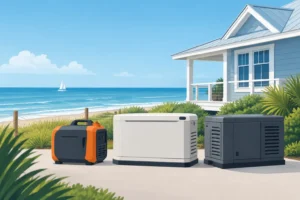
Portable generators can serve a useful purpose for short outages and limited needs. They are less expensive upfront and can be practical for occasional use. But they require fuel storage, manual setup, outdoor placement, extension cords or a properly installed inlet connection, and active supervision.
An automatic standby generator is permanently installed outside the property, similar to an HVAC unit. It runs on natural gas or propane, depending on site conditions and fuel availability. It starts without manual setup, powers the transfer switch, and can run for extended outages as long as its fuel source is available and the system is properly maintained.
That convenience carries a higher initial investment, and site conditions matter. Some properties need propane storage. Others may need gas-line upgrades, electrical-panel work, grading, or permitting. These are not reasons to avoid backup power. They are reasons to work with a contractor who evaluates the entire installation rather than treating the generator as a standalone appliance.
Generac is a trusted choice for many residential and commercial standby applications because it offers established automatic backup power solutions across a wide range of capacities. Depending on the project, Kohler, Cummins, and Briggs & Stratton equipment may also be appropriate. The best brand and model depend on load requirements, fuel, available space, budget, and service needs after installation.
Installation details that protect the property
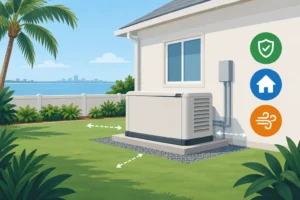
A generator needs more than a level pad and a connection to the electrical panel. Safe, dependable operation depends on proper placement, correct transfer-switch integration, fuel supply sizing, local code requirements, and a plan for service access.
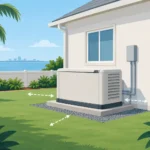
Placement is especially important along the Alabama coast. The unit needs required clearance from windows, doors, vents, and combustible materials. It must sit where exhaust will not affect occupants and where technicians can access it for maintenance. Drainage matters as well. A generator should not be located where standing water or poor grading creates avoidable risk during heavy rain.
Electrical integration determines what happens during an outage. The transfer switch isolates the property from utility lines before generator power is supplied. This protects utility workers and prevents dangerous backfeeding. It also directs power only where the system was designed to send it.
Fuel planning deserves the same attention. Natural gas can offer a continuous fuel source when service remains available, but the gas line must be sized correctly for the generator’s demand. Propane offers dependable on-site storage, though tank size and refill planning become part of the outage strategy. A qualified installer can explain the trade-offs for your property instead of assuming one fuel source fits every home or business.
Jubilee Generator provides the consultation, equipment selection, installation, electrical-panel integration, automatic transfer setup, and ongoing service needed to make the process manageable for Baldwin County property owners.
Keep your generator ready after storm season
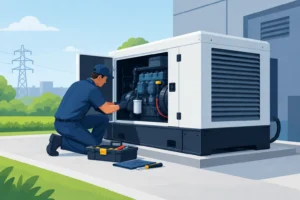
A generator that has not been maintained is not a plan. Standby units exercise themselves on a schedule, but exercise cycles do not replace professional inspection and service. Like any engine-powered system, a generator needs attention to oil, filters, batteries, connections, enclosure condition, software settings, and overall operation.
Before storm season, confirm that the unit runs its exercise cycle and that there are no warning lights or active alerts. Keep the area around it clear of vegetation, stored items, and debris. If your system uses propane, review tank levels and refill arrangements well before a storm is approaching. Waiting until watches or warnings are issued can mean competing with every other customer in the area.
For businesses, write down the operating plan. Identify who receives generator alerts, who can access the property after a storm, and which systems must be checked first. Test communications equipment, refrigeration alarms, security systems, and any equipment that needs a proper shutdown before backup power is exhausted.
Homeowners should also remember that generator power does not eliminate all storm risks. Flooding, structural damage, downed lines, and evacuation orders still require careful decisions. Never operate portable equipment indoors or in enclosed spaces, and never enter flooded areas near electrical equipment. Backup power supports a safer property. It does not replace storm safety guidance.
Make the decision while power is still on
The best time to plan is when you can compare options without a storm track on the evening news. Think through what an outage would mean for your household, tenants, customers, inventory, or operations. Then choose a system that matches that reality, not just the lowest number on an estimate.
A properly sized, professionally installed standby generator gives your property a clear response when the grid goes down: critical systems stay powered, comfort is protected, and you are not left scrambling in the dark. Before the next severe-weather season, make backup power one less uncertainty your family or business has to carry.